The Number Runner
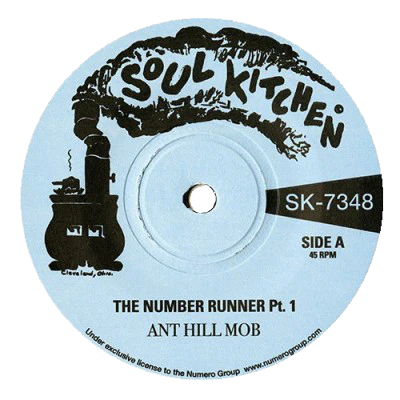
During our excavation of the Boddie Recording Studio, a mysterious tape marked Ant Hill Mob turned up. On our return trip, Dante Carfagna turned up the codex for the entire studio, which lead to the discovery of this unissued Soul Kitchen 45. “Number Runner Parts 1 & 2" falls in right around the time of Boddie’s Creations Unlimited 45, made while breathing the same psychedelic fumes pouring out of Thomas and Louise Boddie’s pressing plant smoke stack.
Ezra “Eddie” Robitson, born into a musical family on Cleveland’s East Side, was taken under the wing of his singing aunt Ruby Carter. Her only soul single, 1971’s “What About Me” b/w “Unlucky Girl,” was pressed at Boddie, issued on Lester Johnson’s Way Out label, and enjoyed modest local airplay. When Ruby’s band the Exceptional Three split, young Eddie was pulled in to handle bass for Carter’s new live band. With chops honed on the Cleveland club circuit, Eddie began drafting a band of his own. Built from fellow John F. Kennedy High alums, his Ant Hill Mob included singer Rahman Melton, trap-setter Mike Wilson, percussionists Norman Robinson and Kenny Clay, and 15-year-old Michael Hampton on guitar. Their 1972 schedule included regular gigs at the Harris family–owned Sir Rah House and Robert’s Steak House (home of the “Big Rob Hamburger”).
The Ant Hill Mob name refers, of course, to Clyde, Ring-A-Ding, Mac, Danny, Rug-Bug Benny, Willy, and Kirby—the tommy gun–toting crew of gangster dwarfs that first appeared in Hanna-Barbera’s Wacky Races cartoon series. The group’s sole recording session saw them at work on a similar fantasy, detailing the lifestyle of a number runner—the pusher, essentially, for illegal, ghetto-based lottery schemes. Neither Eddie nor any member of the group, as far as he knew, ever actually worked in this lucrative field. Records show that Thomas Boddie issued “I’m A Number Runner” with a black-type-on-yellow Soul Kitchen label, pressing an absurdly optimistic 1,000 copies. Although the band members each received a copy, only one example has ever surfaced in the public sphere.
Product Information
Product Information
Shipping & Returns
Shipping & Returns
Description
During our excavation of the Boddie Recording Studio, a mysterious tape marked Ant Hill Mob turned up. On our return trip, Dante Carfagna turned up the codex for the entire studio, which lead to the discovery of this unissued Soul Kitchen 45. “Number Runner Parts 1 & 2" falls in right around the time of Boddie’s Creations Unlimited 45, made while breathing the same psychedelic fumes pouring out of Thomas and Louise Boddie’s pressing plant smoke stack.
Ezra “Eddie” Robitson, born into a musical family on Cleveland’s East Side, was taken under the wing of his singing aunt Ruby Carter. Her only soul single, 1971’s “What About Me” b/w “Unlucky Girl,” was pressed at Boddie, issued on Lester Johnson’s Way Out label, and enjoyed modest local airplay. When Ruby’s band the Exceptional Three split, young Eddie was pulled in to handle bass for Carter’s new live band. With chops honed on the Cleveland club circuit, Eddie began drafting a band of his own. Built from fellow John F. Kennedy High alums, his Ant Hill Mob included singer Rahman Melton, trap-setter Mike Wilson, percussionists Norman Robinson and Kenny Clay, and 15-year-old Michael Hampton on guitar. Their 1972 schedule included regular gigs at the Harris family–owned Sir Rah House and Robert’s Steak House (home of the “Big Rob Hamburger”).
The Ant Hill Mob name refers, of course, to Clyde, Ring-A-Ding, Mac, Danny, Rug-Bug Benny, Willy, and Kirby—the tommy gun–toting crew of gangster dwarfs that first appeared in Hanna-Barbera’s Wacky Races cartoon series. The group’s sole recording session saw them at work on a similar fantasy, detailing the lifestyle of a number runner—the pusher, essentially, for illegal, ghetto-based lottery schemes. Neither Eddie nor any member of the group, as far as he knew, ever actually worked in this lucrative field. Records show that Thomas Boddie issued “I’m A Number Runner” with a black-type-on-yellow Soul Kitchen label, pressing an absurdly optimistic 1,000 copies. Although the band members each received a copy, only one example has ever surfaced in the public sphere.